

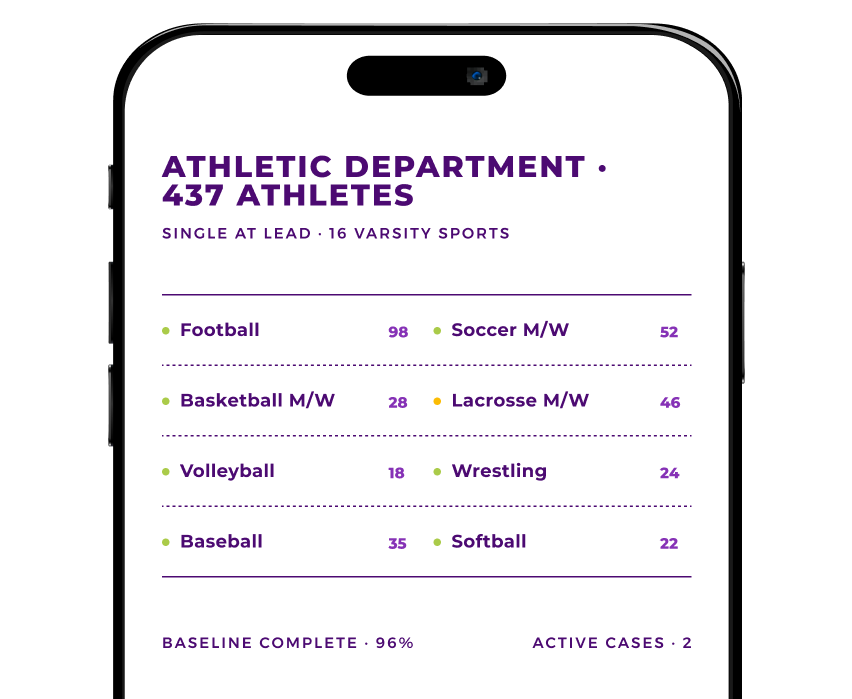
XLNTBrain is the complete concussion management system built for the way D2, D3, NAIA, HBCU, and junior college athletics actually run — multi-sport rosters, lean training staff, real NCAA compliance, and budgets that don’t include enterprise pricing.
Who we serve
Built specifically for the programs that need the most complete tool — not the most expensive one.
Division II & III
Multi-sport coverage with lean AT staff. NCAA-aligned protocols, audit-ready documentation, and pricing that fits a real athletic department budget.
HBCU Athletics
Complete concussion management built for HBCU programs — across SWAC, MEAC, CIAA, SIAC, and independent conferences. Bilingual protocols where you need them.
NAIA Programs
Conference-compliant documentation, multi-sport rostering, and a workflow that one AT can actually run across an entire academic year.
Junior Colleges
NJCAA-friendly pricing and a complete platform that scales with two-year programs. Transferable athlete records when student-athletes move on.
What's inside
Everything a college sports medicine team needs for the full concussion lifecycle.
Native SCAT6 sideline assessment
The full Sport Concussion Assessment Tool 6 — administered from a phone or tablet on the sideline, with results automatically attached to the athlete's record.
Neurocognitive + balance baseline
Every athlete on the roster gets a documented preseason baseline you can compare against — across cognitive performance, balance, and symptom inventory.
Daily symptom monitoring
Student-athletes log how they feel daily. You see the trend without chasing them between classes, practices, and study hall.
5-step return-to-play protocol
Evidence-based graduated return from rest through full contact, with team physician sign-off and documented progression at each stage.
NCAA & conference documentation
Audit-ready records for every athlete — baseline, assessment, recovery, clearance. Aligned with NCAA Sport Science Institute, CDC, and NATA guidance.
Multi-role access
Athletic trainers, team physicians, athletic directors, coaches, and parents (where applicable) each see what they need. Role-based access, no data leakage.
What makes XLNTBrain different
Four things you'll only find here.
MULTI-SPORT
Built for one AT, fifteen sports
D1 programs have a dedicated AT per sport. D2, D3, NAIA, HBCU, and junior college athletic trainers are running football and soccer and basketball and lacrosse — sometimes in the same week. XLNTBrain consolidates the whole roster into one workflow, so an AT can switch sports without switching tools.
HBCU-READY
HBCU athletic department experience
BILINGUAL
Full Spanish-language protocols
CLINICAL
Founded by a board-certified neurologist
How an academic year runs with XLNTBrain
Five stages. One platform. Built for how college sports medicine actually works.
Neurocognitive / Balance / Symptom inventory
Preseason baseline — entire roster
Every student-athlete on every team completes a 20–30 minute neurocognitive and balance baseline online during preseason physicals. Run an entire department in two or three sessions, or send athletes a link before they arrive on campus.
SCAT6 / Mobile-first / Multi-sport ready
Sideline assessment, native SCAT6
When something happens during a game or practice — football Saturday, soccer Tuesday, lacrosse Thursday — pull up the athlete's record on a tablet and run the full SCAT6. The actual protocol your team physician and conference expect, on the device you already carry.
Daily check-in / Push notifications / Return-to-learn ready
Recovery tracking through the academic week
Student-athletes log symptoms daily through the app. You see trends across classes, practices, and weekends. Academic accommodations get documented. Athletic trainers don't have to chase 22-year-olds for status updates.
RTP protocol / Physician sign-off / NCAA-aligned
5-step return-to-play with physician sign-off
Evidence-based graduated progression from symptom-limited activity through full contact, with team physician approval at every stage. Documentation that holds up to conference review and institutional risk management.
NCAA reporting / English + Spanish / Audit-ready
Audit-ready documentation, exportable
When the NCAA, the conference, the institutional risk officer, or a future employer asks — export the record. Every baseline, every assessment, every recovery step, every clearance. English and Spanish both available.
From the Field
"You can actually understand what you're looking at — it's easy to administer, and it provides a step-by-step recovery assistance plan with daily symptom tracking which gives us data to help make a decision about their condition to play or practice."
Stephanie Guzzo, ATC · Assistant Athletic Trainer, St. Mary’s College of Maryland
Built for compliance
The boring stuff, handled.
CLINICAL
Founded by a neurologist
NCAA
Conference & NCAA documentation
PRIVACY
FERPA-aware, HIPAA-aligned
Questions sports medicine directors ask
Answers, in plain English.
Can one athletic trainer manage concussions across all our varsity sports with XLNTBrain?
Yes — that's exactly who XLNTBrain is built for. D2, D3, NAIA, HBCU, and junior college programs typically run with one or two athletic trainers covering 15+ varsity sports. XLNTBrain centralizes baselines, sideline assessments, daily symptom tracking, and return-to-play across the entire department, so the AT can switch from football Saturday to soccer Tuesday to lacrosse Thursday without switching tools.
Is XLNTBrain a good fit for HBCU athletic programs specifically?
Yes. We've designed XLNTBrain to serve HBCU athletic departments — across SWAC, MEAC, CIAA, SIAC, and independent conferences — with realistic pricing, complete multi-sport coverage, and the same clinical rigor as any major program. We're an active partner to the HBCU sports medicine community, not just a vendor selling into it.
Does XLNTBrain meet NCAA concussion protocol requirements?
Yes. XLNTBrain's protocols are aligned with NCAA Sport Science Institute guidance, CDC Heads Up, and NATA position statements. The platform produces audit-ready documentation for each student-athlete's baseline, post-injury assessment, recovery progression, and clearance — meeting institutional and conference compliance requirements.
Is the platform available in Spanish?
Yes. XLNTBrain offers full Spanish-language concussion education, baseline testing, and assessment materials, supporting bilingual student-athletes, international athletes, and Hispanic-Serving Institution (HSI) campuses. The same compliance workflow runs in either language.
How does XLNTBrain handle return-to-learn alongside return-to-play?
Daily symptom tracking captures cognitive load alongside physical symptoms, giving athletic trainers and team physicians the data they need to communicate with academic affairs about accommodations — exam postponements, reduced screen time, modified attendance. Return-to-learn and return-to-play documentation lives in the same record.
Who built XLNTBrain?
XLNTBrain was founded by Dr. Harry Kerasidis, a board-certified neurologist with 25+ years treating brain injuries. The platform's clinical logic reflects how a neurologist actually wants concussions managed — not how a software team approximated it.
How much does it cost for a college athletic department?
Pricing is institutional and based on roster size, sport count, and program needs. We've built XLNTBrain to be accessible for D2, D3, NAIA, HBCU, and junior college budgets — not enterprise-priced for D1. Request a quote and we'll send you a number, not a sales cycle.
What does implementation look like for a college program?
Most athletic departments are live within two to three weeks. We help you import your roster across all sports, configure NCAA-aligned compliance settings, and run baseline sessions in coordination with your preseason physicals. From there, your AT and student-athletes use the app — we stay on call.
See it for your department
One platform. The whole department. Built for the way college sports medicine actually works.
Book a 30-minute demo and we’ll walk through the workflow with your actual program in mind — your athlete count, your sport mix, your state’s compliance needs.